The History and Meaning of the Miraculous Medal

The Miraculous Medal is one of the most widely worn Catholic devotional items in the world. An estimated hundreds of millions of people wear one at any given time. But its origin story is extraordinary: this medal was designed not by a jeweler or an artist, but by the Blessed Virgin Mary herself.
In 1830, a young French nun received a vision that would change Catholic devotion forever. This is the full story of the Miraculous Medal : its history, the meaning behind every symbol, and why it still inspires faith nearly 200 years later.
The Apparitions to Saint Catherine Labouré (1830)
On the evening of July 18, 1830, a 24-year-old Daughter of Charity nun named Catherine Labouré was awakened by what she described as a "shining child" who led her to the chapel of the motherhouse at Rue du Bac in Paris. There, the Blessed Virgin Mary was sitting in a chair near the altar.
Catherine knelt at Mary's feet, resting her hands on Mary's knees. Mary spoke to her for two hours, telling her that God had a mission for her, that difficult times were coming for France, and that she should come to the chapel whenever she needed to pour out her heart.
Then, on November 27, 1830, during evening meditation, Catherine saw a vision that would become the Miraculous Medal. Mary appeared standing on a globe, crushing a serpent beneath her feet. Rays of light streamed from her hands, and around her was an oval frame with the inscription: "O Mary, conceived without sin, pray for us who have recourse to thee."
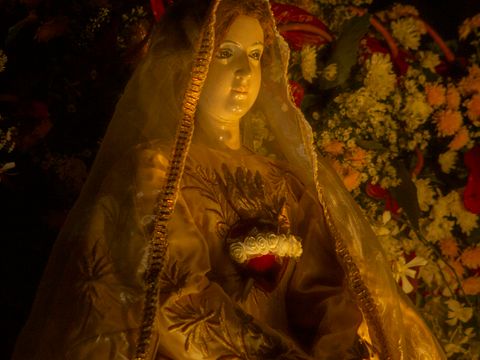
The vision then turned to show the reverse of the medal: the letter M surmounted by a cross, with two hearts below — the Sacred Heart of Jesus (crowned with thorns) and the Immaculate Heart of Mary (pierced by a sword) — all surrounded by twelve stars.
Mary instructed Catherine: "Have a medal struck according to this pattern. Those who wear it will receive great graces."
The Design: Every Detail Has Meaning
The Front of the Medal
- Mary standing on a globe — she is Queen of Heaven and Earth, and she crushes a serpent (Satan) underfoot, fulfilling Genesis 3:15
- Rays of light from her hands — these represent the graces Mary obtains from God for those who ask her. Catherine noted that some gems on Mary's rings did not emit light — Mary explained these represent graces that people forget to ask for
- The inscription — "O Mary, conceived without sin, pray for us who have recourse to thee." This was 24 years before the dogma of the Immaculate Conception was officially defined in 1854
- The year 1830 — the date of the apparition
The Back of the Medal
- The letter M — for Mary, surmounted by a cross, showing her intimate connection to Christ's redemption
- The Sacred Heart of Jesus (crowned with thorns) — His love for us, despite our sins
- The Immaculate Heart of Mary (pierced by a sword) — her suffering as foretold by Simeon (Luke 2:35)
- Twelve stars — representing the twelve apostles and the vision of the Woman in Revelation 12:1
Why Is It Called "Miraculous"?
In short: Originally called the "Medal of the Immaculate Conception," the faithful renamed it "Miraculous" after countless reported healings, conversions, and graces. The most famous miracle was the instant conversion of the atheist Alphonse Ratisbonne in 1842.
Originally called the "Medal of the Immaculate Conception," it was the faithful themselves who renamed it the "Miraculous Medal" after the extraordinary number of healings, conversions, and graces reported by those who wore it.
The most famous miracle: the conversion of Alphonse Ratisbonne, a militant atheist and anti-Catholic who, on January 20, 1842, had a sudden and overwhelming vision of Our Lady in the church of Sant'Andrea delle Fratte in Rome — while wearing a Miraculous Medal that had been given to him as a challenge by a Catholic friend. He converted immediately, became a priest, and spent his life serving the Church.

How to Wear and Use the Miraculous Medal
- Wear it around your neck: as Our Lady instructed, keep it close to your heart
- Pray the inscription daily — "O Mary, conceived without sin, pray for us who have recourse to thee"
- Trust in Mary's intercession. The graces come through faith and devotion
- Have it blessed. A medal blessed by the Pope carries additional spiritual significance
- Give it to others. Share the devotion with family, friends, and those who need Mary's help
The Miraculous Medal Today
Nearly 200 years after the apparition, the Miraculous Medal remains one of the most popular Catholic devotional items worldwide. The chapel at Rue du Bac in Paris, where Catherine received the vision, receives over 2 million visitors each year. Saint Catherine Labouré's incorrupt body is on display there.
At Catholically, our Miraculous Medals are blessed by the Pope in St. Peter's Square and shipped directly from Rome — continuing the tradition that began with a young nun's vision in a Paris chapel. They make beautiful gifts for every sacramental occasion.

Browse All Miraculous Medals →
The Worldwide Spread of Miraculous Medal Devotion
Within just a few years of the first medals being struck in 1832, the devotion spread quickly across Europe and then the entire world. By 1836, over two million medals had been distributed in Paris alone. Missionaries carried the medal to Africa, Asia, and the Americas, and reports of graces and conversions followed wherever it went.
The Daughters of Charity, Catherine Laboure’s own religious order, became the primary evangelizers of the devotion. They distributed medals in hospitals, schools, and prisons, and the results were striking: deathbed conversions, sudden healings, protection from epidemics. During the cholera outbreak in Paris in 1832, the Sisters distributed thousands of medals to the sick, and many attributed their recovery to Our Lady’s intercession through the medal.
Today, the devotion spans every continent. The Association of the Miraculous Medal, headquartered in Philadelphia, coordinates devotion in the United States and has distributed hundreds of millions of medals since its founding. The National Shrine of Our Lady of the Miraculous Medal in Perryville, Missouri, draws pilgrims year-round. In Rome, the church of Sant’Andrea delle Fratte, where Alphonse Ratisbonne experienced his conversion, remains a major site of Marian devotion. And of course, the chapel at Rue du Bac in Paris continues to welcome over two million visitors each year, where Catherine Laboure’s incorrupt body rests in a glass reliquary beneath the very altar where she received the vision.
How to Properly Wear and Pray with the Miraculous Medal
Our Lady’s instruction was simple and clear: “Have a medal struck according to this pattern. Those who wear it will receive great graces.” Wearing the medal is the primary devotion, and here are the traditional practices that help you receive the fullest graces from this powerful sacramental.
Wear it close to your heart. The most traditional way is on a chain around your neck so it rests near your chest. This keeps Our Lady’s image close to you throughout the day, a constant reminder of her maternal protection. Some Catholics also pin a small medal inside their clothing, attach it to a rosary, or keep one in their wallet or pocket.
Pray the inscription daily. The words “O Mary, conceived without sin, pray for us who have recourse to thee” are not just a motto. They are the prayer Our Lady herself gave us through the design of the medal. Many devotees pray this invocation three times, morning and evening, as a simple but powerful daily practice.
Pray the Miraculous Medal Novena. The novena, prayed over nine consecutive days, is one of the most popular novenas in the Church. It includes the Memorare, the Hail Mary, and specific prayers asking Our Lady’s intercession. The Perpetual Novena, held weekly in parishes around the world (particularly on Mondays), has been a source of countless graces since it began in the 1930s.
Share the medal generously. Part of the Miraculous Medal’s power has always been in its distribution. The tradition of giving medals to those who are struggling, sick, or far from the faith follows Our Lady’s own desire that the medal be widely spread. At Catholically, every Miraculous Medal is blessed by the Pope, making it an especially meaningful gift for someone you love or someone in need of Our Lady’s intercession.